emissions of materials and products inside habitats
limiting chemical pollution of indoor air and olfactory discomfort (volatile organic compounds (vocs), aldehydes, odors)
Each person spends an average of 22 hours out of 24 in enclosed or semi-enclosed spaces: housing, workplaces, public venues (schools, nurseries, hospitals...). Products and materials found in these spaces (coatings, paint, furniture, candles, household appliances...) emit chemical pollutants into the air and unpleasant, even irritating odors. These emissions can impact air quality and potentially represent a long-term health hazard, especially for the most vulnerable people, such as children, the elderly, or the sick.
Thus, for any product manufacturers, builders, or project owner, it is necessary to qualify, quantify, and reduce volatile organic compound emissions and odors from your materials and products.
Regulatory Context
The European Regulation (EU) 2023/1464 of July 2023 imposes limiting formaldehyde emissions by August 2026 to a rate of :
- 0.062 mg/m³ for furniture and wooden articles
- 0.080 mg/m³ for all other articles (paragraph 1 of the restriction)
(Regulation (EU) 2023/1464 Amending Annex XVII of REACH Regulation ((EC) No. 1907/2006), Entry 77)
impacts for manufacturers and distributors
- Manufacturers must adapt formulations, manufacturing methods, and material choices if the product does not comply with this future regulatory application.
- Distributors must ensure compliance with formaldehyde emissions, either through supplier verification or by conducting laboratory controls.
verification of emissions from construction and decoration products
french regulatory labeling
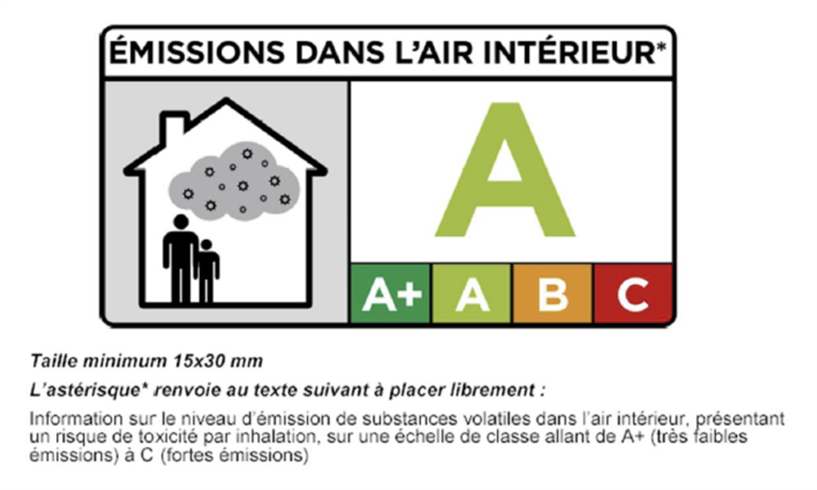
All construction or decoration products covered by French Decree No. 2011-321 of March 23, 2011, must be labelled according to their air pollution level: A+ , A, B, or C, from the least to the most emissive. These analyses are conducted in compliance with requirements for CE marking of construction products.
analyses for the european and international market
The laboratory adapts its analyses to the requirements of the international market
The requirements of each country are taken into account in the analyses, in addition to those carried out for the French market.
Complementary compounds can be sought, and samples can be adapted according to the standards considered. This way, your products can be marketed in several countries.
analysis of carcinogenic, mutagenic, reprotoxic (cmr) substances
Construction materials must not emit more than 1 µg/m³ of CMR in the air. This includes trichloroethylene, benzene, DEHP (Di(2-ethylhexyl) phthalate), and DBP (Dibutyl phthalate)
Bureau Veritas Laboratoires performs the analyses and indicates the measured CMR content in the products
"voluntary" product emission analyses or to respect ou to comply with a specific label
Development axes for regulations on other consumer products were promulgated in the national indoor air quality plan (June 2013): regulatory labelling should be applied to: Furniture (especially for children), Candles and air fresheners, Household products
Bureau Veritas helps manufacturers or distributors to anticipate the evolution of these regulations, to communicate about the quality of their products, and to anticipate potential authority controls (market withdrawal through the precautionary principle).
Bureau Veritas performs "custom" analyses taking into account current regulations and planned development areas for:
- Furniture and toys for nurseries, schools, or hospitals
- Electrical and electronic equipment
- Household and health appliances
- Wood materials, plywood, laminated, MDF panels
- Construction/decoration products not covered by regulations
- Mass distribution articles
ECOLABEL: paint and varnish manufacturers, deadline June 17, 2027 — are you ready?
The common challenge: deadline June 17, 2027, file submission by end of 2026.
- Current holders: your 2014 certification version must be updated according to 2025 criteria.
- New applicants: this is the ideal time to position yourself in this demanding market.
The new European criteria (EU Decision 2025/2607) strengthen controls on indoor air emissions.
Why is this transition an opportunity?
→ Market differentiation: demonstrate authentic environmental commitment.
→ Enhanced trust: meet your customers' growing expectations.
→ Preserved access: maintain your eligibility for the most demanding projects.
Our support at Bureau Veritas :
We support you throughout your entire process: product selection, required emission measurements, through to analysis reports to guarantee your compliance with the new ECOLABEL criteria.
new materials, recycled materials
The laboratories also support you in your development and innovation of new materials or products (for example, to meet regulatory incentives to use recycled materials).
It is possible to guide your developments with the help of rapid analyses to classify the least emissive, before carrying out regulatory analyses, which often take longer in terms of deadlines.
sustainable and green buildings
Many building labels (or certifications) have more or less strict requirements to encourage the use of low-emission materials in construction and renovations: for example, for LEED, BREEAM, HQE, WELL BUILDING, etc.
The laboratories support manufacturers and project managers to verify emissions according to the requirements of each label. Counter-analyses or 100% checks can be carried out and allow the products to be compared with each other.
-
main methods used and products concerned
ISO 16000-9, ISO 16000-10;
ISO 16000-11; ISO 16000-6, ISO 16000-3
Construction and Decoration Products Used in Living Spaces / Furniture CMR Regulation (since January 1st, 2010) Any construction material with a limit of 1μg/m³ in emissions of trichloroethylene, benzene, DEHP, and DBP. Upcoming Regulatory Methods Furniture, candles, incense, air fresheners, maintenance products ANSES Protocol (Former AFSSET one) Construction products, and any product proving indoor air quality ISO 16000-25 and ASTM D7706-11 Any material, for rapid in air-emission study AgBB, EMICODE, M1, GUT, CRI,.. All materials, international tests EN120, NT EN717-3 et NF EN 717-1 Wood materials VOC Tests for CE Marking Construction products -
analysis Methods
- Thermal desorber with gas chromatograph coupled with mass spectrometer and FID
- Headspace with gas chromatograph coupled with FID
- Liquid phase chromatography
- Team of 10 olfactory panellists in the laboratory
- Emission chambers up to 1 m³ with olfactory cone
- Emission cells
- Tedlar® bags
- Active Tenax® sensors, passive Radiello® sensors
- Micro-chambers
Why Choose Bureau Veritas?
Technical Expertise
Bureau Veritas technicians and engineers implement material emission analyses in compliance with current standards and regulations.They advise you on the samples or specimens to send to the laboratory according to the required packaging conditions.
Reconnaissance
Bureau Veritas Laboratories is accredited* by COFRAC (French national accreditation body, signatory member of ILAC) according to NF EN ISO/CEI 17025 standard (Nr. 1-0036, site of Cergy, scope available on www.cofrac.fr).
The quality of services is monitored through inter-comparison tests, such as those organized by BAM (Bundesanstalt für Materialforschung und –prüfung).
*consult : https://documentation.bureauveritas.fr

